I ran across this article in BusinessWeek, and thought it would be good to share with everyone:
http://www.businessweek.com/smallbiz/content/oct2008/sb20081024_482729.htm
It offers an interesting view on logistics businesses, which will be the career path of many in our class.
Does everyone agree that the business is "built around personal relationships and trust"?
-Andrew Freeman
Sunday, November 30, 2008

Vote on Blogging and Inventory Management
Now that the semester is almost over, I think that it is an appropriate time for our class to assess the value of this blogging assignment.
Personally, I think that the blogs did not achieve Dr. Keskin's desired results set forth at the beginning of the assingment. There are probably many reasons for the outcome; however, I would suggest that future classes only maintain one blog as opposed to eight different blogs.
Does anyone else agree? What about a conflicting opinion?
-Andrew Freeman
Monday, November 17, 2008
Thoughts on "Human" Inventory
Citi Bank announced this morning that they would be cutting approxiamately 50,000 jobs. This is just one example of a company cutting jobs as a result of the stagnating economy.
I believe that we can look at this situation and apply some of inventory management principles (however, this opinion might be far from the truth).
For instance, these companies are drastically reducing their levels of human capital, which means they will have to do more with less. They are basically trying to run a leaner organization, which could possibly be related to a company reducing the amount of inventory they carry by employing lean concepts.
On the other hand, there is also an increasing supply of unemployed workers in the marketplace. These unemployed individuals are probably willing to work for a smaller salary in light of these uncertain economic times. If we consider the workforce as a cost, then companies can now take advantage of acquiring their workforce at a reduced rate.
Does anyone have any thoughts or opinions on this subject???
-Andrew Freeman
Sunday, November 9, 2008
Everybody's thoughts on the future of American Autos
In light of the recent news that has surfaced from the "Big Three" American auto companies, I was interested to discuss the effects that this news has on their inventory policies. My guess would be that these companies are going to be stuck holding massive amounts of finished goods inventory and incurring exorbiant holding costs on these items. I am curious to know whether these increased inventory levels will pose any downward pressure on prices in the marketplace?
Furthermore, as our economy has progressively slowed down, does anyone have thoughts on the amount of inventory that these companies are going to be stuck with holding?
Thoughts, Ideas, and Opinions are welcome!
Andrew Freeman
Furthermore, as our economy has progressively slowed down, does anyone have thoughts on the amount of inventory that these companies are going to be stuck with holding?
Thoughts, Ideas, and Opinions are welcome!
Andrew Freeman
Thursday, October 23, 2008
Inventory as an asset
The company I used to work with usually holds a special inventory, a considerable amount of our own products for our R&D use for the development of next generation systems. It is an inventory and an investment as well. Wall Street doesn't like that and usually considers it as a negative effect on the stock price. But we have to maintain those systems for new products.
I have no idea how they achieve an optimal quantity of that inventory. I doubt they ever use
any inventory control on it.
-Bing Liu
Sunday, October 19, 2008
BBJ Article - Honda Accord
http://www.bizjournals.com/birmingham/stories/2008/10/13/daily1.html?surround=lfn&brthrs=1
This article describes the recent decision by Honda to start producing their Honda Accord in their Alabama manufacturing plant. According to the article, this decision has adjusted the overall production mix for the Alabama plant, which means their other "Alabama" vehicles will now be produced in smaller quantities (the Honda Pilot and the Honda Odyssey).
I thought this article was interesting because it can relate to some of the materials in our OM 523 class, specifically the Economic Production Quantities. Production managers at Honda must be keenly tuned into their demand patterns for ordering decisions, because their production rates are now changing. Therefore, in order for the company to avoid stock-out costs as well as avoid producing too many of these vehicles, their inventory managers must alter the EPQ calculations.
-Andrew Freeman
Tuesday, October 14, 2008
WSJ Article - "Firms Struggle with Commodities Costs"
Amidst the growing economic concerns that our country is facing, many businesses, both large and small, are experiencing significant changes to their cost structure(s). This article does a good job of highlighting the broad-spanning increase in commodities costs, which are causing havoc for many organizations.
We can relate this article to our EOQ discussions from class (Pause briefly for an outburst of pure excitement!!!)
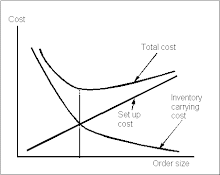
The fundamental objective for our EOQ models is to minimize total costs, which is primarily a function of ordering and holding costs. As a result of violent fluctuations in the costs of various commodities, there has been an abrupt shift in firms' ordering and holding costs, which effectively changes an organization's EOQ calculations. For example, the increasing price of gasoline has made transportation more expensive; thus, these increasing transportation costs have changed relevant ordering costs for many products.
-Andrew Freeman
Subscribe to:
Posts (Atom)